Tuesday, January 24, 2012

Emilia's English Corner

Private tuition: Emilia Colacelli (Microfinance Consultant)


Lesson No.1                                                                                       materials (PDF)


Translation of 'A VER"


Lesson No.2                                                                                                        materials (PDF)

Listening with Argentinian Astrotnomist 


Lesson No.3                                                                                                    materials (PDF)

Writing with Santa Evita


Lesson No.4 

Parts of Speech Practice


homework


Lesson No.5                                                                                                             materials (PDF)

Revision


Lesson No.6                                                                                                             materials (PDF)

Reading with The World Bank


This month's crossword


Lesson No.7                                                                                                         materials (PDF)

Grammar/prepositions with The World Bank Conference


Useful Language for Conferences


Crossword answers 


The Torrents of Spring is a short novel written by Ernest Hemingway, published in 1926, and his first. Hemingway used the work as a parody of the world of writers at the time (and more directly of Sherwood Anderson's Dark Laughter).

Written in 10 days, its satirical sense of humour is directed subliminally at pretentious writers of the time. It is widely believed that Hemingway wrote The Torrents of Spring in order to break his contract with his publisher Boni & Liveright, and to make fun of his writing peer (and friend), Anderson.


While you're reading please post any questions or comments below – I will get a notification immediately and respond to you! (:


Monday, January 23, 2012

Jorge's English Corner

Private tuition: Jorge Zaiatze (Kidney Specialist, Co-founder & Director of Caseros Sanatorium) 


Lesson No.1 


General Fluency – Steve Jobs book discussion


Lesson No.2

Making Offers & Suggestions with cards


Lesson No.3


Speaking – Personal Details


Discover the magic word!


Lesson No.4


General Fluency – Steve Jobs


Lesson No.5 

Fluency with 2nd Conditional cards


Lesson No.6

GEneral Fluency


Lesson No.7                                                                                                              materials (PDF)

Fluency – Giving Directions

home-made listening text


Lesson No.8 

Role-play: renting a car


Lesson No.9

General fluency – TED talk discussion


Lesson No.10

General Fluency – crossword answers


Lesson No.11

General fluency – gap fill activity


Lesson No.12

General Fluency – this month's crossword


Lesson No.13                                                                                                   materials (PDF)

Reading


Lesson No.14


Lesson No.15


General fluency – Discussion with reading and useful language 


Friday, January 20, 2012

Jokes and the Linguistic Mind

commentary


Debra Aarons, who teaches linguistics, believes much of the knowledge we have about language is unconscious and that a very good way to explain a linguistic point, is through a good joke.
A linguistics lecturer is giving a class on negation . . .      
     'In some languages,' he explains, 'such as Italian, you need only one negative item for the sentence to have negative polarity. In some languages, such as Afrikaans, you require two negative items for the sentence to have negative polarity. Whereas, in some other languages, two negatives will give you a positive polarity, as in English. However, in no language do two positive items yield a negative polarity.' And then from the back of the hall comes the students' response, 'yeah, yeah,' and 'yeah, right!' . . . . . . 
(From Debra's book Jokes and the Linguistic Mind.)


She says that jokes can tell us something about the organisation of language in the mind.


Another. . .
     A [stereotypical] blonde walks into a library, walks up to the reference desk, and says, 'I'd like to get a double burger, a packet of chips and a diet coke, please.' The librarian looks at her in absolute horror, and she hisses, 'this-is-a-li-bra-ry!' The woman responds, 'Oh! I'm so, so sorry,' and whispers, 'I'd like to get a double burger, a packet of chips, and a diet coke, please.'
In practise, Debra uses this joke to teach pragmatics and speech act theory (an utterance considered as an action, particularly with regard to its intention, purpose, or effect) in order to point out that we have to recognise the intention of a speaker, not just the words. Above, the stereotypical blonde got the intention of the librarian: that she was being rebuked; she was doing something wrong. However, not being so smart, she didn't realise what she was doing wrong.

Debra comments that every time we speak we convey intention. Be it criticism, apology, demand, request or rebuke as with the joke above. She says that's called 'elocutionary force' and the point is we know how to respond to it. A text book example: someone walks into a room and says 'Ooh! It's hot in here,' not commenting on the weather per se, but suggesting someone open the window or turn on the air-conditioner. With this, Debra makes the point that speaking is something we do, rather than exchanging simply true or false propositions.

Sunday, January 15, 2012

Candian English according to 'Canuck'*, Joe Clark

commentary


    According to Joe, the spoken language is a dialect that comes from the United States, i.e. it is classified today as American English. However, the accent is exceedingly neutral and one struggles to tell where a Canadian speaker might be from. Which is not true of English in the US, whose accents more readily denote a speaker's region, be it Texan, Jewish New Yorker, African American, northern, southern, eastern, western. The letter Z is pronounced 'zed' in Canadian English unlike the 'zee' of the US. The lexicon yields a few hundred uniquely Canadian words.

      Orthographically, there is a mix between American and British Englishes. 
Canadian English utilises Z in the spellings of suffixes -ise, -yse: organize, realize, paralyze, utilize. Whereas words that end in -our, 'honour', 'colour', 'ardour', 'fervour', and which end in -reas in 'centre', 'theatre', 'litre' follow the British convention. Lexical sets are again shared between American and British Englishes and one can see that many words used for technology, trade and physical objects are of American English. For example: tire (tyre), curb (kerb), carburator (carburettor), truck (lorry), gasoline (petrol), trunk (boot). Whereas financial vocabulary, for example 'cheque' (not check), also follows the British convention. As do 'practise', the verb, and, 'practice', the noun. Likewise, 'licence' and 'license'. Double your consonants in 'travelled', not traveled, 'controllable', not controlable, 'counselling', not counseling
Why so?
     After the Revolutionary War when the yet-to-be United States declared independence from the United Kingdom, and when those remaining loyal to the British Crown were persecuted, belongings and land confiscated, refuge was sought in the remaining British colonies in the north of the continent. These Loyalists** brought with them their dialect, the American English of that time, an influenced British English, whose most influential feature was its post-vocalic Rs and a few vowel sounds. Owing to proximity, trade, television and more, for over two centuries Canadian and Northern American accents merged somewhat,  in affect diluting the British qualities of the language.
      In 1998, Oxford University Press, after five years of research, produced The Oxford Canadian Dictionary. Remarkably, it sold about 400, 000 copies and enjoyed 'best-seller' status, as did the second edition for several months. It helped Canadians to settle many arguments and to unify on issues related to spellings, pronunciation and language identity


      According to a survey by Joe, Canada's orthography is today largely consistent across Canada.


*Canuck: colloquialism for 'Canadian' 
**Loyalist: a colonist of the American revolutionary period who supported the British cause

Tuesday, September 13, 2011

'erstwhile' a definition


erstwhile'ə:stwʌɪl adjective[attrib.] former: the erstwhile president of the company. adverbarchaic formerly: Mary Anderson, erstwhile the queen of America's stage.

Oxford Dictionary of English (2nd Edition revised)
© Oxford University Press 2005 All rights reserved.


'Indeed, Turkey's threats to give naval escorts to future Gaza aid convoys, if acted upon, risk a high-seize confrontation between Turkey and its erstwhile, Israeli ally.'

Saturday, September 03, 2011

Professional Development | Tecnoimagen In-Company Lessons


Tecnoimagen in-company lessons


Lessons held through Wall Street English, which means materials are copyright protected.


3 Sept 2011 – 28 Feb 2012


tailored materials:


vocabulary matching


regular v irregular verbs 


eliciting questions with 'Have you just....?'


Revision


Tuesday, August 30, 2011

Professional development | Climate Change Class – WSI

This lesson began with a reaction from learners to some comments I wrote on the board taken from a internet discussion thread on climate change. Comments were either for or against climate change being a result of humankind. NOTE the slips of paper containing all comments had been misplaced at the school, therefore writing two or three of them on the board that came to mind served almost as well.

I seated groups according to level, and learners discussed for a short time the views on the board with moderate interest. A good idea might have been to ask that they write onto slips of paper their own views, shuffle and redistribute them, in order to promote some early oral fluency on the topic. I then chested some pictures to the class which contained colour illustrations of various historical epochs (extinct dinosaurs, stone-age people around fires, melting icecaps), and in groups they matched the illustrations with various epoch titles, then those with the correct dates.

Prior to this, I had laid long datelines across each groups' table. However, in retrospect, putting them on the tables later would have been better because learners now started that activity too too early; a task like this should be staggered.

What I wanted to highlight, in order to encourage debate, was some of the changes coming into effect in the world in our relatively short existence.


I read aloud the true dateline for them to check against. Beginning 64 million years ago and reaching the present except for two timeline nodes.

I revealed the remaining dates, 'less than 1 lifetime ago: we used up half the world's oil supply,' and
'just 15 years ago: the development and deployment of the world-wide web.'

As we were running out of time there was a brief final discussion. Considering the large size of the class, I think we did quite well.


listening text from ABC Radio National

We need to evolve to cope with the problem. Not physically but culturally. Not biological evolution, but systems evolution. We would need to use the collective capacity of human beings, from the local community, to the regional community through to the global community. We need conviction of the problem, understanding; we need to know what people are doing in other communities and other places.


Whether man-made or not, climate change is in effect and is seen to be worsening exponentially, thus we are trying to work to find solutions. 

But the history of humanity is that things often have to get very much worse before we actively try to make them get better – why should things be any different in terms of our current crisis?


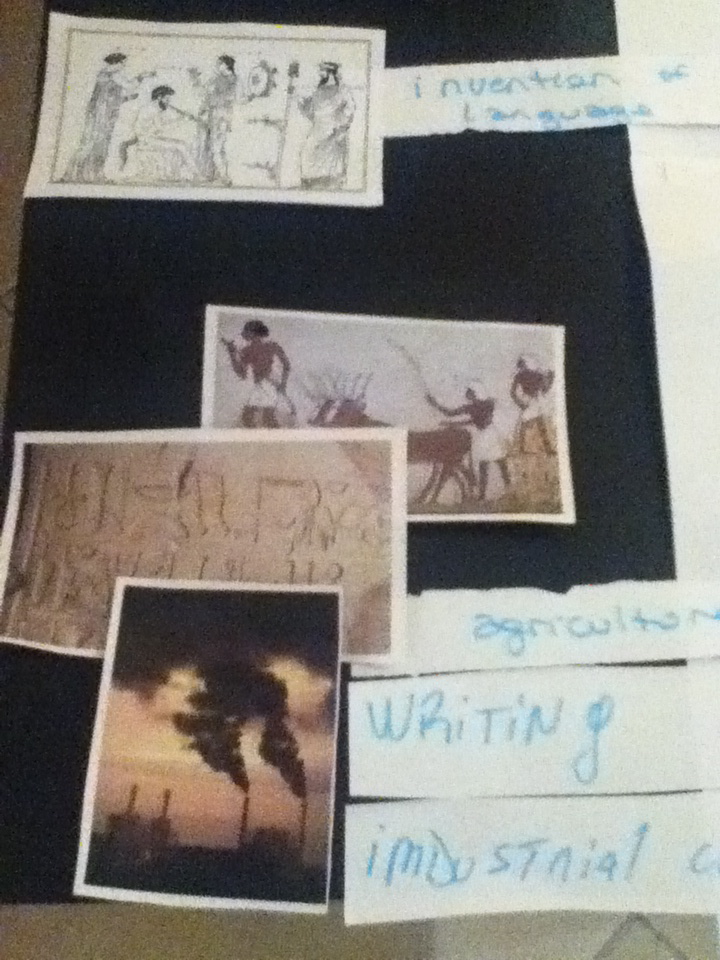
We usually think of the history of humanity as an unimaginably long period of time, but if we adjust that scale and think in terms of lifetimes, it’s not that difficult to see that, actually, we haven’t been around that long and there’s been a great deal of change,

64 mil years ago                                      dinosaurs became extinct
2 million years ago                                  climate change. the seas were rising
125, 000 years / 1, 800 lifetimes ago(laid end-to-end) our species, homo sapiens sapiens
1, 000 lifetimes ago                                            invention of language
570 lifetimes ago                                            the stone age
140 lifetimes ago                                                agriculture
70 lifetimes ago                                                       writing
3 lifetimes ago                                            industrial civilisation

< 1 lifetime                            we’ve burnt up half the world’s oil


and 1/5 of a lifetime (15 years)    the development & deployment of the WWW


in light of all this, implications are that we can affect change, and we need to consider how it is affected. And so we see, the changes are of our lifetime and that what can happen in our lifetime can be enormously significant.


One way I attempt to fathom it is by thinking about some of those smaller things we do currently and enlarging or extending those into the bigger picture: thinking of that next person in the community as someone connected rather than not – one you have cleared your rubbish at your seat in the park for, the rubbish collector you've separated your domestic waste for, one you've left reading material in the waiting room for, sent the lift down for, planted a tree for – someone who is unseen and unknown to us, yet we are smart enough to know that these small measures help. It is in this same sense, in our current situation, that we need to extend certain considerations to the next generations.

(in class the teacher could elicit many of those small things we do that make a big difference, e.g. turning of the lights, the air-conditioning, riding a bicycle, solar energy.)

It’s not that we might be sadistic, a take-as-you-need society, reckless or careless towards the environment and Earth's ecosystems, rather we just don’t know how to see it and act. 

Having said that, as awareness and understanding spreads and as warming goes on increasing, so does the culpability of larger institutions and companies who have a greater ability at quick change and prevention of damage. 

All the same, the most apparent solution in my mind, as we see the solution of having one singular world-government becoming less viable, lies in the collective will power of the individual

Change begins with one. Even the mightiest waterfalls
have begun with a single drop of water, and look what becomes of that.

Iguazu Falls, Argentina

Monday, August 29, 2011

Professional development | Book Club class no.2 – WSI

Fruits of students' efforts in our second Book Club class.

Using a newspaper article about the London Underground or subterranean railway network to encourage ideas on how they could improve their own transport system the learners were asked to read and jot down suggestions, first alone, and then in groups. Some seemed not greatly interested in the task.

To be fair, we'd discussed the subway in a previous lesson, where learners read a collection of subway-themed poems (Goldfish, Mosquito, and Tow Logs) and walked around like passers-by themselves in 'subways' reading various billboards. In that lesson some good, meaningful discussion had come about. 

The lesson I had prepared was tasked-based. The aim of the lesson was 'to develop skills of reading for gist and oral fluency through task-based activities.' This was a Friday night and the learners were tired. But also there was a new mix of learners, some of whom hadn't been in the previous lesson.

This was not a lesson for slow discussion about book themes and plot, etc., but a skills lesson based on books as materials. Skills and language development are achievable within one  sixty-minute lesson.
  
The pictures above some ways to improve the city's transport system, a post-reading activity.

In Literature by Alan Duff and Alan Marly (Oxford University Press), the book from which I took this lesson's article on the London Underground, it states that literature is better used to stimulate language activities by 'engaging the students interactively with the text, with fellow students, and with the teacher,' favouring this over a study of literature per se (either from the literary critical or the stylistics viewpoint). 

Some other comments:
'[with this approach] The student is an active agent not a passive recipient.'
'The activities should offer ample opportunities for the students to contribute and share 
their own experiences, perceptions, and opinions.'
'The text should be allowed to suggest the type of activity. This means breaking away from  
the stereotypical format of text and questions.'
'Texts can be presented in a variety of ways. This may sometimes mean withholding the 
text until the end of an activity, cutting it up, using fragments of it only, and so on.'

But then what about real literature? The book comments further:
'[this approach] might be seen as failing to teach real literature and taking literature 'seriously', by which is generally meant a body of texts recognised as great literature [...] There is nothing sacred about a literary text. All such texts were at some time written down, rearranged, scratched out, torn up revised, misprinted, and so on. Anyone doubting this should simply look at any well-known writer's notebook or manuscript.'
'More importantly perhaps, if students are encouraged to adopt a 'hands on' approach to texts, they are likely to lose some of the awesome respect which the literary printed word inspires, and which gets in the way of the individual reader/interpreter's personal response to the text.'
Any practice is good practice, and it was still a good skills lesson.

In future I'll continue to find ways to energise the class and perhaps adapt materials.