Tuesday, July 30, 2013

Professional Development | Accenture In-Company Lessons


Accenture in-company lessons


REPORTS – JULY


Friday, July 19, 2013

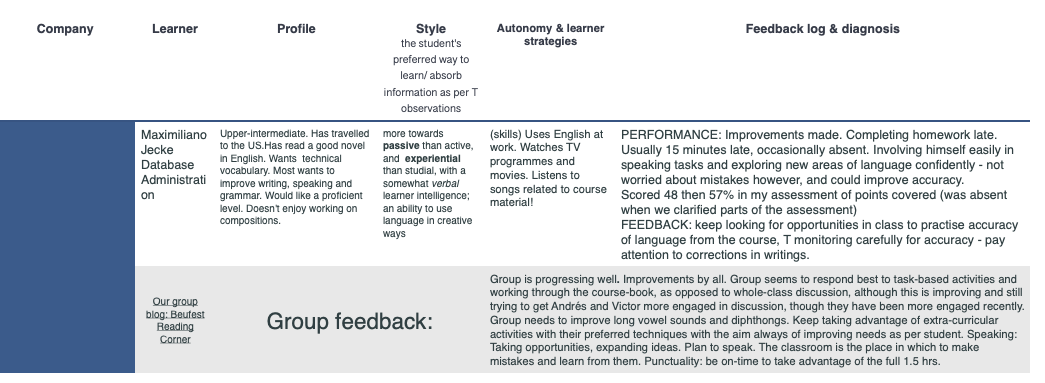
Professional Development | Baufest In-Company Lessons


                                                                Baufest in-company lessons


                                                                 lesson plan here and here


Great class today! beginning with a warm-up discussion on football, oil companies, and subtitled media. 

We started by correcting a letter containing spelling mistakes in pairs. 

No sooner had all learners arrived I listed 18 of the mistakes on the board and eliciting correct spelling rules which they produced with the aid of some photocopies of rules I had placed at their table. Learners said they had been exposed to British spellings in school, US through subtitled television and they used a mix. They said spelling might depend on whom one is writing to.

Following this we moved to the main-aim task of the day: vocabulary for ways of speaking (e.g. whisper, mumble, shriek). Learners used dictionaries to look up meaning, pronunciation, and example sentences. I watched as they made up examples speaking, writing, and shared information in groups — I didn't see anyone making notes on pronunciation though. Afterwards I drilled a few words containing longer, more difficult vowel sounds, which also served to prepare them and to segue into the next task: Stop The Bus.

Learners elicited the new vocabulary and their teams guessed the words correctly, writing them on the board. 

The team writing all words first  (A)  shouted 'stop the bus,' and the exercise was over. Some quick feedback and it was already 10 o'clock.

Outside the classroom learners collected individual homework tasks, which all aim at consolidate language covered during the course.


Sunday, July 14, 2013

when might may not be may

commentary

As sometimes I need to clarify when to use modal verbs 'may' and 'might', and as they are both so often interchangeable, I today discovered some examples of when it is usually

may rather than might, e.g. the planet Venus may be seen clearly in the night sky during this month | The seeds from the plant may grow up to 20 centimetres in length | Exceeding the quoted dose may cause drowsiness – i.e., for academic language to talk about the characteristics or behaviour of something,

and

might rather than may, is sometimes used to talk about what was typically the case in the past, e.g. During the war, the police might arrest you for criticising the king | Years ago children might be sent down the mines at the age of six | In the early 19th century a person might be sent to Australia for stealing as little as a loaf of bread,

in all of which examples 'may' and 'might' are not usually interchangeable.

We can use might or may for a possible situation, e.g. I may go to Ireland | I might go to Ireland, but only might when the situation is not real. For example, If I were Tom's parents, I might look for a better job – you are not in Tom's position, you will not look for a better job.

Other, more everyday examples include: 

may I leave now? | May I help you? | you may not leave now – for permission

might they go by bus? (or could) – for possibility in the interrogative form (may they would imply permission), rather formal.

Historically, 'might' is the past form of 'may', but that fact doesn't offer any help in clarifying any current day usage of these two modal verbs. *I do, however, tell my students to change 'may' to 'might' when using reported speech (I may move to Sydney = he said he might move to Sydney).

Wednesday, July 10, 2013

Professional Development | Baufest In-Company Lessons


                                                                Baufest in-company lessons


                                                                 lesson plan here and here


REPORTS – JULY


Monday, May 27, 2013

Do we need theory? (OUP Webinar, 2013)

Commentary commentary 

I have found ELT theory useful. I can understand why I am doing something in a particular stage of a lesson in a particular way and I try to understanding what transpired or why.

I think, in turn, it also helps in giving feedback. 

Historically, owing to a cultural move away from formal approaches to ELT, with the success in the 70s of discovering a variety of somewhat effective communicative approaches, since then attention towards and enthusiasm for 'theory' has fallen to make way for such aELT 'revolution'. However, it is still important. 

On the other side of the coin, I understand the effects of too much focus on theory, losing a little common sense when the thinking about why I do something may momentarily preclude my observation of it (and recognition of potentially key evidence). A general feeling for things may be lost when focussed on what I should be doing at a certain time in class. 

A lesson's spontaneity may be stifled by over-planning. This versus the shortcomings of not having planned anything is known as the 'planing paradox'.

Something I gained from Oxford University Press webinars — which I take almost every month —  regarding theory was to think of a classroom as a constellation of individuals with very specific individual needs; it was explained too much focus is on general guidelines and theories and principles, gleaned from textbooks or taught in teacher training, that capture general truths in ELT (and pedagogy). This, to me, sheds some light  on a disconnect between theory and practice I work with — it’s not possible for a reading activity to run perfectly if the TL clarification of key vocabulary stage is interrupted (by so many everyday occurrences, e.g., lateness, classroom overexcited settling down, classroom too tired, persistent questions difficult to control, and more).

It is often better to consider each class unique, the learners, the settings, any variables, and it might be better in the reading activity example to quickly cut down the task. 

Routine reflection by the teacher based on specific goings-on in a unique classroom, COMBINED with the teacher's own theories as to why something happens, should inform practices. Links  should be made between these reflections and the evidence in the classroom. Any theory that rests solely on a priori, i.e. theory that comes from reasoning, intuition, or revelation, from textbooks or the like, should be shelved and referenced. 

Textbooks and literature help get one cogitating and fire up the imagination, but once read through, the classroom itself is then the best textbook. 

The webinar disambiguated 'theory' for me in three ways: firstly, theory in its very powerful 'Einstein' shape and form, which is very general, abstract, and difficult to explain – string-theory, for example. Secondly, a principle-based 'Bach' theory, which again aims at capturing very general truths, but aims more at telling us what should be constructed and what should happen as a result (music composition as in the case of Bach). This is the reason for which we don't do things at random — it is this last type, it stated, that the ELT world focussed on too heavily. And finally, there is the theory that we use to account for a situation or justify a course of action, which is much more specific, particular, and connected to the everyday-world, which it described as an 'Agatha Christie' (or Sherlock Holmes) type theory (e.g., ‘the explanation is that the thief got in through the open window, and that's why you were burgled').

‘Who needs theory? — We all do!’ (OUP Webinar, 2013)

It is an important function of theory formation to advance from 'naïve' and unreflecting 'realism' to a more conscious understanding of the principles and concepts underlying one's actions.

– Stern, 1983 
 
Without theory, experience has no meaning. 
Without theory, one has no questions to ask. 
Hence without theory, there is no learning.

– William Edwards Deming

Tuesday, May 14, 2013

Professional Development | AMEX In-Company Lessons


AMEX in-company lessons


This is your place for extra materials, entertainment, to ask questions related to English, and to leave comments, at any time!


Stop in for a coffee, to review, and to practise!

SKILLS | Listening


SKILLS | Reading

 There's a good article on page 48 of your coursebook; complete the questions and we may discuss it in class!

SKILLS | Writing

  
describing / drawing the AMEX shares graphs with cards


SKILLS | Speaking

/ə/ = about, common, standard, international, America


        /ə/
humour = you

/ekw/     /ə/
acquaintance = day

/ki:n/
keen = beach, sheet, me


LANGUAGE | Vocabulary


acquaintance
step-mother
keen (enthusiastic)
abroad
overseas
belongings
belong
lyrics
lighthouse 


LANGUAGE | Grammar

Find examples of grammar on page 17 of your coursebook (and exercises on page 18) 


LANGUAGE | Functions

How many questions can you make in one minute with:

how, who, which, where, what, when, did, does, do, have, has, whom, whose, how long, how old, how far, how many, how much, how tall, why?

Great, now try again, but only using either past, present, or future tense. 


Friday, May 03, 2013

ISBAN's Reading Corner

ISBAN in-company lessons


Please find here extracurricular materials, a place to ask questions and also to leave comments.

Good Luck! 


warm-up with music 'Mad Trio' musical composition


DO WE DRINK TOO MUCH COFFEE? (article)


This article has reactions by people to the bcc article above


And this from a Chilean student of mine:

Actually I prefer tea instead off coffee, but it doesn’t mean that every Chilean has my same likes J

In Chile, we use to have the “the tea time” or known as “once”, is a meal between lunch and dinner, in Argentina it’s like “merienda”. In this meal the Chilean people use to drink tea, that’s why the name “Tea time”. So thinking about this we can infer that Chilean people prefer tea, although there are a lot of starbucks and other coffe places in the city.

I hope my answer will help you!


state

froth

brew

career

Sibling

pang

(to) tend

outlook

(to) stifle

(to) get on with

streak


Next week...


Thursday, May 02, 2013

WSI


A sample of what I used to post on a language institute's blog I worked at, to advertise their weekly skills classes:


(S2 S3 W1)


this poster was displayed at the institute and on the institute's blog and Facebook page

In this series of classes Ss watch a 25 minute episode of HBO series In Treatment, which portrays the troubled lives and psychotherapy sessions of a varied set of interesting characters. Ss answer questions to develop listening skills, while also increasing Ss' awareness of vocabulary related to human emotions and attitudes. More significantly, by using video Ss will see the language in use, match intonation to facial expressions etc., and also be shown via demonstration what may be needed in a role-play activity.


acting out idioms of time – WSI

"to turn back the clocks,


to burn the candle at both ends,


on the spur of the moment,


a race against time."